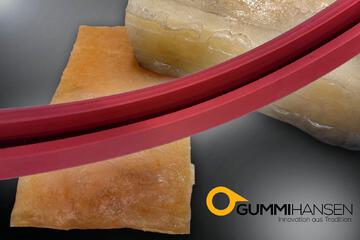
NBR (nitrile rubber)
What makes NBR (nitrile rubber) so relevant for industrial applications?
What makes NBR (nitrile rubber) so relevant for industrial applications?
NBR is a synthetically produced acrylonitrile-butadiene rubber. This copolymer is characterized by a combination of high resistance to oils and greases, alongside impressive mechanical properties. Due to its polar nature, NBR is incompatible with aromatic and halogenated hydrocarbons, ketones, esters, strong acids and alkalis, oxidizing chemicals, as well as ozone and UV radiation.
Core material properties of NBR (depending on the compound formulation):
- High abrasion resistance
- Excellent tear and tensile strength
- Low compression set
- High elongation at break, good flexibility, and compressibility
- Low gas permeability
- Comparatively slow thermal ageing
The functional temperature range typically spans from –30 °C to +120 °C. The exact performance depends heavily on the acrylonitrile (ACN) content (18% to 48%), which governs both temperature tolerance and chemical resistance. Additionally, its ozone resistance can be enhanced by blending it with PVC.
Chemical resistance (depending on the compound formulation):
- Alcohols
- Animal and vegetable oils and fats
- Dilute acids and alkalis
- Mineral oils and fuels
- Aliphatic hydrocarbons
- Silicone oils and greases
Typical fields of application: NBR is widely used in seals, hoses, diaphragms, and other components that require robust media and temperature resistance.