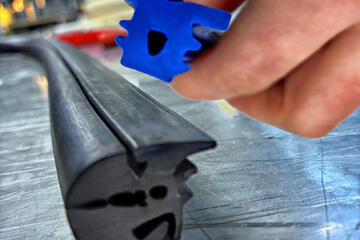
Synthetic rubber EPDM
Ethylene propylene diene monomer rubber
Synthetic rubber EPDM
Ethylene propylene diene monomer rubber is a synthetic elastomer material produced by the copolymerisation of ethylene, propylene, and a diene with non-conjugated double bonds. EPDM can be crosslinked using either peroxides or sulfur.
EPDM stands out for:
- Very good ozone and weathering resistance
- Low heat ageing
- Temperature resistance from -50 °C to approx. 150 °C
- Very good resistance to polar substances, hot water, and steam
Disadvantages: Limited resistance to petrol, fuels, and mineral oils.Gummi Hansen GmbH offers extruded and moulded articles (CM, IM, TM) in EPDM with hardness levels ranging from 25 to 95 Shore A. Extrusion enables the production of both intricate profiles and large-volume seals for hydraulic steel structures. For this application, GH also provides an EPDM compound compliant with DIN 19704-2 (as well as in NR/SBR). Profiles can be converted into rings or frames using hand-fabricated, butt-joint, and film vulcanisation.
Furthermore, wrapped articles such as hoses with and without textile reinforcements can be manufactured. In industrial hoses, the fabric reinforcement provides additional pressure and dimensional stability.